Are Tensile Umbrellas the Future of Sustainable Design?
March 05, 2026 By admin
Are Tensile Umbrellas the Future of Sustainable Design?
Are Tensile Umbrellas the Future of Sustainable Design? Then Ambient Enterprises is the best place for Tensile Umbrellas. When seeking to be more sustainable in the built environment, architects and designers continually seek ways to develop solutions that are not only environmentally friendly but also aesthetically bold and operationally effective. Go inside the Umbrella Tensile Structure, an architecture that appears to resist gravity with its beautiful billowing shapes. However, regardless of its undoubted beauty, is it the template of the future of sustainable design? How such beautiful structures are making a strong argument for themselves, we shall see.
What Is a Tensile Structure?
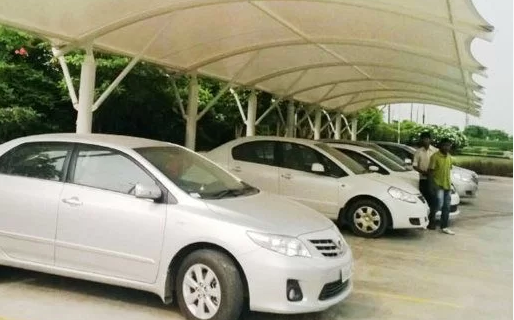
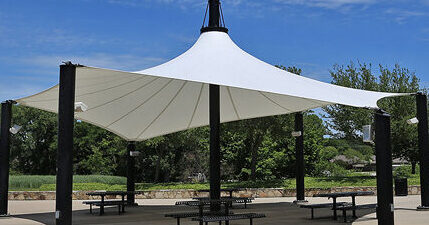
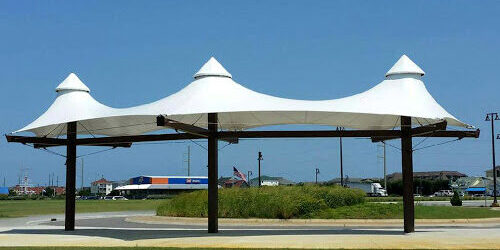
In its simplest form, a tensile structure is a type of construction that is united through tension. It does not use the bulky compression members such as the traditional beam but employs a stretched mechanics of membrane (the fabric), held up by masts and secured by connected cables. A certain and usually modular type of tensile structure is an umbrella tensile structure in which a single mast carries a canopy (akin to an umbrella) to form a column-free shaded area below. Herein lies the most important principle, which is the key to its sustainable benefits.
- Efficiency and Minimalism Material Old-fashioned buildings are also wasteful, and they use more material than is required simply out of precaution. Membrane structures made of tensile membranes reverse this script. The fabric skin is so thin that it is in tension, which means that each square inch of substrate is working to provide strength to the structure. This leads to the creation of radically efficient use of resources. A tensile solution requires a smaller portion of a material compared to a solid roof over the same area, and at the very beginning, tensile-covered structures have a lower embodied carbon footprint.
- Harnessing Light and the high-tech fabrics of the contemporary tensile designs (e.g., PTFE-coated fiberglass or ETFE foil) can be designed to play around with light marvelously. They can disperse direct sunlight, which is harsh, producing a soft, glare-free light that does not mean using artificial lighting in the daytime. The prospects of integration are enormous in the future. The photovoltaic cells may even be attached to or deposited on the membrane, turning a passive shade provider into a productive power producer. Think about a tensile walkway system that does not just ensure that you stay dry when it rains but also uses the sun to light the lights on the pathway at night.
- A Light Touch on the Land tensile structures are lightweight structures that do not need as many foundation plants. This light-touch method is not so intrusive to natural scenery; soil integrity is maintained, and this type of building is suitable when erecting over sensitive regions or building restaurants in a difficult soil site. It is a philosophy of working in harmony with the land and not subjugating it.
- Semiqualterity and Climatic Sturdiness do not let their frail figure mislead. Tensile fabrics of high quality are designed in such a way that they are incredibly resistant to degradation, as well as to UV and corrosion, and microbial activity. As well, they clean themselves most of the time, which decreases the maintenance and thus issues regarding such chemicals. Also, their aerodynamic forms are natural in shedding wind and snow, which makes them more resilient to the rising wind and snow events.
- Fusion of Form and Function, as well as the Bioclimatic Design tensile membrane system, is not a roof but a bioclimatic design device. This, by designing shaded, comfortable settings in the outdoors, is, by implication, promoting natural airflow and living outside versus closed spaces, which are energy-intensive to cool or heat. It is a characteristic of progressive sustainable architecture to marry form and functionality in this smooth way.
The Future Is Collaborative
To make the best out of these structures takes skills and imagination. Ambient Enterprises and other firms are companies whose business is this complex design, a process of engineering accuracy and artistic expression. It embodies a breathtaking single umbrella tensile structure in a public park or a large tensile walkway connection of buildings in a corporate campus, which is the cooperation of the designer, engineer, and fabricator that affects the sustainable theory of becoming a built reality.
The Verdict
Tensile umbrellas, therefore, are the future of sustainable design? They are undeniably an important and strong constituent of it. They represent several major values that we should adopt: extreme resource efficiency, energy awareness, and the positive connection to the natural environment. They demonstrate that sustainability does not imply the sacrifice of beauty or innovation. It may even be the catalyst for it. The tensile structure will dominate our future as we continue to construct cities in the future, gracefully, intelligently, and efficiently, into the future.